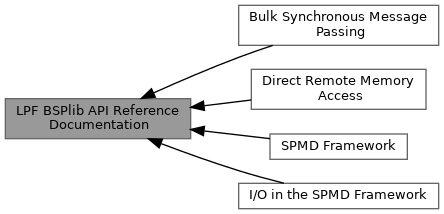
Modules | |
| SPMD Framework | |
| I/O in the SPMD Framework | |
| Direct Remote Memory Access | |
| Bulk Synchronous Message Passing | |
Detailed Description
LPF can presents a group of networked computers as a Bulk Synchronous Parallel (BSP) computer programmable by means of the BSPlib C API. This means that programs using this library will adhere to the BSP cost model, in so far the user can guarantee that no shared resource is used and that the only I/O happens through the network interface as provided by the LPF BSPlib. The BSP cost model states that the running time of a program will be no longer than:
\[ W + H g + S l \]
where W is the total amount of computation per node, H is the total amount of communication per node, and S is the number of supersteps in which the program is divided. The parameters g and l depend on the computers and how they are networked. To determine them, careful benchmarking has to be performed. More helpful explanation of the BSPlib interface and the BSP cost model can be found in literature, e.g. :
- "BSPlib: The BSP Programming Library" by Jonathan Hill et al.
- "Parallel Scientific Computing" by Rob H. Bisseling. 2004, Oxford University Press
This document is a reference guide of the BSPlib API, which span the following modules:
- The SPMD Framework and some remarks about I/O.
- The Direct Remote Memory Access API
- The Bulk Synchronous Message Passing API
- Copyright
- Copyright (c) 2017 by Huawei Technologies Co., Ltd.
All rights reserved.